OpenZhenZhen AI 提示词画廊 · SEEDANCE2.5 · video
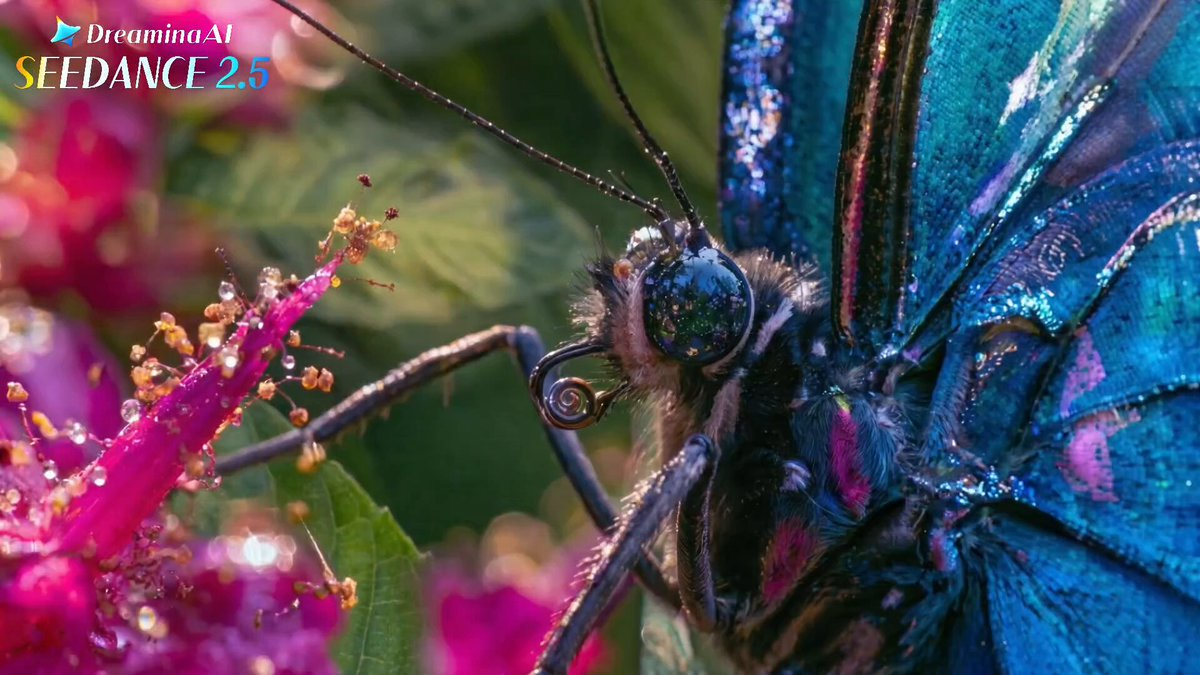
Macro Butterfly Nature Documentary Shot
公开作者的 SEEDANCE2.5 视频案例,包含完整 prompt 和可播放成片。
提示词 / Prompt
English prompt
【Video Specifications】 16:9, 1920×1080, 24fps, ultra-realistic wildlife macro cinematography. Bright tropical morning, natural sunlight from the upper left corner of the frame passes through plants, creating clear but soft golden sunrays. A small amount of real suspended dust and pollen particles exist in the air, visible only in sunlight. ARRI Alexa 35 cinematic texture, professional ultra-macro probe lens, realistic shallow depth of field, natural bokeh, detailed motion blur, and slight cinematic grain. The entire film is a single continuous shot, no editing, no reset, no morph. No background music. 【Reference Images and Consistency】 The uploaded butterfly close-up image must be exactly the first frame and the only character and environmental reference throughout the film. Do not add a second ending image. Maintain the same blue morpho butterfly throughout: same head, compound eyes, black body hairs, cobalt blue and greenish-blue iridescent wings, dark wing edges, and purple-pink subtle textures. Always maintain four properly connected wings, six slender black legs, two antennae, and one curled proboscis. Prohibit changing species, head size, wing patterns, or body proportions. Camera focus must consciously shift sequentially rather than keeping the entire frame sharp: Compound eyes → flower stamen and pollen → wing scales → full butterfly. Each focus transition must be achieved through real lens rack focus, lasting approximately 0.4-0.7 seconds. Prohibit sudden blurring, random defocusing, or AI-style focus pumping. 【0-4 seconds | Compound Eyes and Natural Life Feel】 Start directly from the ultra-close-up compound eyes of the reference image. Compound eyes remain in sharp focus, showing dense compound eye structures, tiny reflections of tropical gardens and sunlight. The camera is not stationary but moves in an extremely slow arc trajectory around the head approximately 25 degrees while slightly moving forward. The butterfly maintains realistic micro-movements: one antenna slowly sweeps the foreground, the other antenna produces slight independent movement; head makes small angle adjustments; proboscis slightly retracts; thorax and abdomen show extremely subtle undulations with breathing. Nearby petals are gently moved by the breeze. Prohibit the butterfly from being completely motionless like a static model. Focus remains locked on compound eyes, with foreground stamen naturally blurred. The camera slowly slides forward along the butterfly's line of sight toward the magenta stamen, causing the compound eyes to gradually defocus. 【4-8 seconds | Focus Transfers to Flowers and Pollen】 Complete the first natural rack focus: compound eyes gradually blur, magenta stamen, dewdrops, and golden pollen come into sharp focus. The camera glides laterally near the stamen, passing over wet petal surfaces and transparent dewdrops. Dewdrops must realistically reflect the blue wings and surrounding green plants. One front foot of the butterfly moves forward and gently touches the stamen. A real contact must occur first, causing the stamen to bend and rebound, then releasing a small amount of fine pollen. Pollen does not explode but slowly enters sunlight as dozens of particles of different sizes, some closer to the lens creating natural depth of field parallax. The curled proboscis slowly extends toward the flower center, moving continuously, smoothly, and biologically accurately. The camera continues moving along the stamen toward the butterfly's body, briefly focusing on a few golden pollen particles attached to the front foot's fine hairs. The butterfly remains identifiable in the background but stays softly blurred. 【8-12 seconds | Focus Transfers to Wing Microtexture】 The camera glides upward along the front foot to the thorax and wing base, completing the second rack focus: stamen gradually blurs, wing base and tiny scales come into sharp focus. The butterfly begins slowly opening its wings. The camera moves parallel to the wing surface several centimeters away, clearly showing millions of overlapping real micro-scales, tiny wing veins, and dark wing edges. As the camera angle changes, structural colors naturally shift from deep blue to cobalt, greenish-blue, and blue-violet; color changes come from light angles, not from illumination or magic effects. The wings complete only one full natural opening motion, not mechanical repeated flapping. The weak air current from the opening pushes petals, dewdrops, and previously released pollen. A small amount of pollen rotates upward through sunlight, creating a delicate airborne micro-pollen effect. Some extremely small dewdrops are lifted by the air current but movement must follow weight, inertia, and gravity. The camera always remains on the outer side of the wings, never passing through wings, body, or flowers. Wings can pass near the lens but never completely block the frame or cause shape distortion. 【12-15 seconds | Full Presentation and Short Distance Takeoff】 The camera quickly but smoothly pulls back and slightly ascends, completing the third focus transition, transitioning from wing microtexture to the full butterfly. The butterfly's entire body comes into sharp focus, four wings correctly structured, six legs still naturally grasping petals. The butterfly first slightly lowers its body, wings lift upward for power; then takes off from the flower with a strong downward wing beat. The cause-effect relationship must be clear: legs first release petals, petals bend downward due to reaction force, body gains upward and forward acceleration, then petals rebound. Prohibit direct floating, teleportation, or powerless shrinking. The butterfly only performs one short-distance natural takeoff, flying forward and upward along the sunlight direction. Wings maintain fast but slightly irregular realistic flapping. The camera synchronously pulls back and makes slight lateral tracking, keeping the butterfly clear in the air while allowing magenta flowers, floating pollen, and golden sunrays to form clear spatial layers. In the last second, the butterfly flies from the foreground to the midground, still maintaining the same appearance and wing patterns. The camera remains in dynamic tracking mode, not landing on the second flower, not suddenly freezing, not switching scenes. 【Camera and Focus Principles】 The camera continuously performs subtle arc movements, lateral glides, surface tracking, and final smooth pulls back, never using rigid fixed shots. Movements must be delicate, stable, and have realistic macro photography spatial parallax. Focus changes must be clear and narrative-driven: Compound eyes most sharp, flowers blurred. Stamen, dewdrops, and pollen most sharp, butterfly softly blurred. Wing scales most sharp, flowers blurred. Finally pulling back to have the full butterfly in sharp focus. Prohibit entire frame being fully sharp, also prohibit subject suddenly blurring without reason. Shallow depth of field must come from real optical distance, focus plane smoothly moving. 【Physical and Environmental Details】 Pollen and dust can only move due to front foot contact, stamen rebound, or wing air current, prohibit random appearance without reason.
主题与风格
探索更多图片和视频提示词 · 生成图片 · 生成视频 · 在 AI 画布中创作
相关作品
- Mother and Baby Dragon Flight
30-second photorealistic cinematic wildlife sequence. A vast mountain valley in warm morning light, with a winding river, forested slopes and enormous rocky peaks. A gigantic mother dragon and her much smaller baby dragon fly together through the landscape. They look like believable living animals
- The Last Chime In Brass Bells
Cinematic 2.5D animation in the style of fully painterly rendering, characters and environments look like gouache concept-art paintings in motion, visible brush texture on skin, cloth and buildings, flat posterized color blocks with hard-edged light shapes, matte finish, soft filmic volumetric light
- A Baby Dragon Among Cherry Trees
Horizontal 16:9 cinematic 30-second live-action fantasy short film, music-video style fast-paced storytelling. Exactly two characters in the whole video: one young woman and one baby dragon. No duplication or cloning of either character. Audio: soft birds, gentle wind, crunching cherries, light play
- Valentina Returns to Rebuild Empire
Create a 30-second premium cinematic sequel trailer titled: VALENTINA SCARLINA PART II — THE EMPIRE RETURNS ORIGINAL NON-IP CHARACTER. Do not reference or imitate any existing movie, character, actor, celebrity, game, or franchise. IDENTITY: Use the uploaded female face as the strict identity ref
- Female Warrior In Floating Colosseum
GLOBAL CONTINUITY: Photorealistic cinematic 16:9. Keep the EXACT same young East Asian woman, sharp jawline, intense focused eyes, sleek black bob haircut, wearing a minimalist high-collar dark slate-grey robe with leather wrist wraps. Environment is a cracked ancient floating stone colosseum high a
- Subway Fantasy Fight Choreography
全部角色、背景群众与车站环境统一使用明显经过数字雕刻的高级AAA奇幻游戏CG外观,人物近景必须保持精修游戏角色脸、清楚的编辫发束与风格化写实皮肤,不变成真人演员、cosplay、普通gameplay、2D动画或赛璐璐。保留现代地下车站中的超自然格斗场景,不改成中世纪城堡、雪山或拳击擂台。色彩为低饱和冷青灰、深炭黑、青灰鳞皮与冷白灯带,少量黄色护栏、红色信号灯、青铜护目框、铜锈绿肩甲和赭红腰带形成局部色彩;眼睛的蜂蜜金光与击柱时的短紫光只出现在对应瞬间,不全片染成紫色。环境:宽阔而昏暗的地下铁路站,中央下沉轨道区、钢轨与碎石,两侧高出轨道的站台;站台边缘是玻璃金属屏蔽栏与黄色竖向边框,地面有黄色