OpenZhenZhen AI 提示词画廊 · gpt-image-2.5 · image
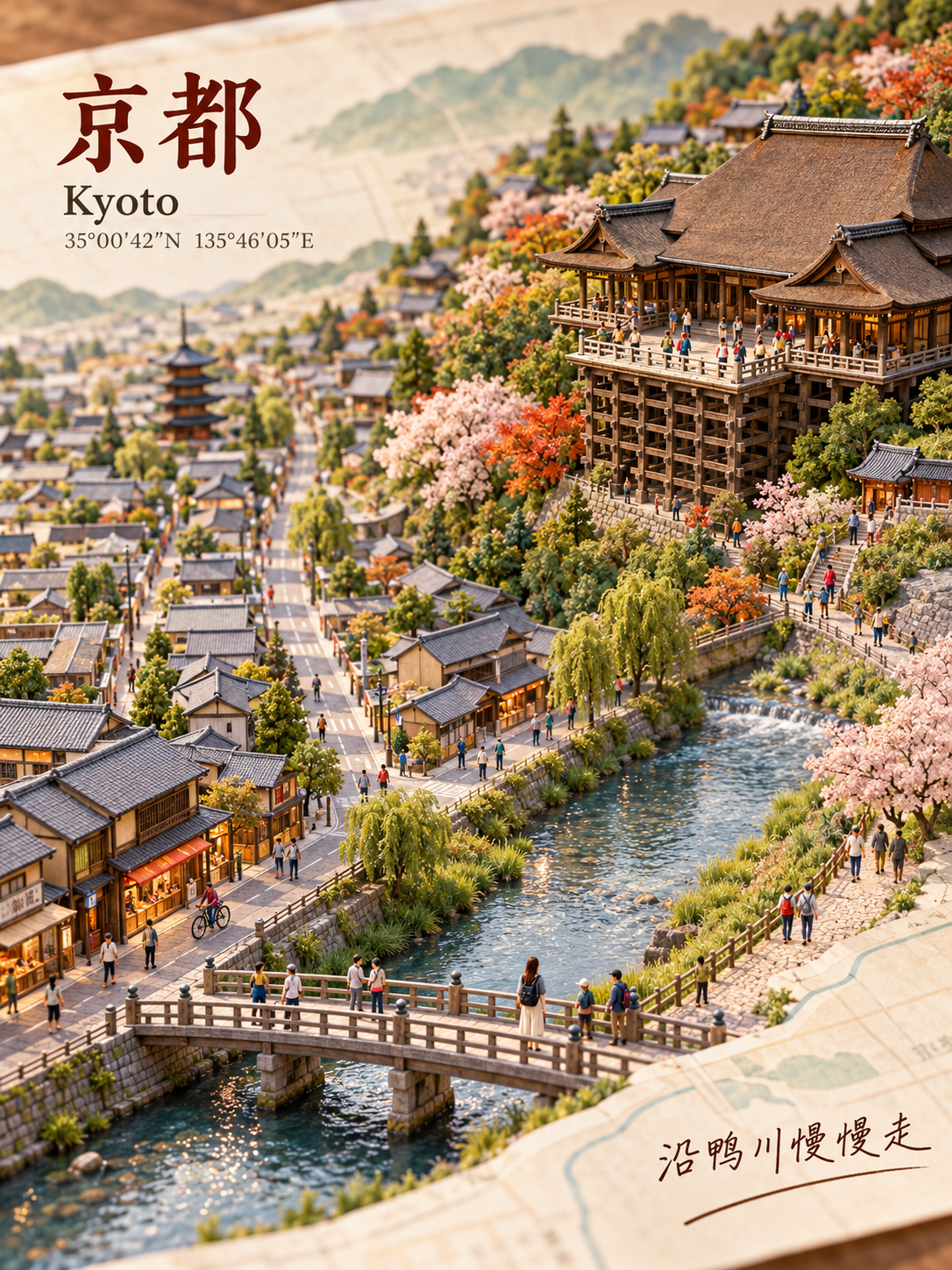
京都纸上生长的3:4微缩城市旅行封面
A 3:4 Miniature City Travel Cover Growing on Kyoto Paper
一张3:4竖版旅行封面:京都城市街区从纸质地图自然生长为微缩模型,以清水寺为主地标、鸭川和棋盘式中心街区为辅助场景,强调真实方位关系、70%可辨认地理与30%几何简化、纸张与微缩模型材质、准确地名/坐标/短句排版。
提示词 / Prompt
中文提示词
创作一张京都(英文名:Kyoto)的3:4竖版微缩城市旅行封面。 真实地理依据 按已核实的地点资料组织地图:京都中心街道呈棋盘式格局,鸭川流经市区。清水寺位于东山音羽山坡地,以木构清水舞台与桧皮葺屋顶为标志。主场景:清水寺坡地与舞台;辅助场景:鸭川沿岸日常步行、中心棋盘街区的商铺与自行车。保持这些地点的地图方位关系一致。。代表性城市参考坐标为35°00′42″N 135°46′05″E;它仅作为城市参考点,不代表测绘精度。保留上述河流、山坡和街区的空间关系,不虚构地理、建筑、地标或地方习俗。 主视觉 呈现一座经过艺术简化但仍可辨认的真实城市,约70%为清晰可读的地方地理与地标,30%为克制的几何抽象。城市从铺在桌面的干净纸质地图中连续生长:印刷道路逐渐成为立体街道,平面地形形成低矮起伏,建筑自然接触纸面。不出现独立底座、漂浮岛屿或模型被另行摆放的感觉。 以前景东山坡地上的清水寺、向外挑出的木构舞台与独特桧皮葺屋顶(英文默认值:Kiyomizu-dera on the eastern hillside, with its projecting wooden stage and distinctive cypress-bark roof)作为主要场景;加入鸭川沿岸日常步行与桥边小憩(英文默认值:an everyday walk and a small bridge-side pause along the Kamo River)和京都中心棋盘式街区中的小店与自行车生活场景(英文默认值:a small shopfront and bicycle activity within Kyoto's central street grid)两个较小辅助场景,并遵循地点资料中的真实方位关系。三个场景共呈现15–20个局部尺度统一、约1:87模型人偶质感的微缩人物。前景安排一位明确成年的主要游客,其身份绑定已配置的ref-10a-v1;所有人偶面部都保持微小、无细节,不画可识别的真人面孔。动作简单可读,脚接触地面、手与物件接触合理;画面拥挤时先减少次要人物。 构图与材质 采用高机位斜俯视,让地图布局、屋顶和建筑侧面同时可见,透视方向一致。主体城市模型位于中部至下部,约占三分之二空间;一个清楚的主要地标,两个辅助场景。左上留白放地点常用中文名,其下放通行英文名和代表性坐标;右下留白放沿鸭川慢慢走(英文默认值:A slow walk by the Kamo River)。文字和留白不得遮挡关键地理。 表现细腻纸纤维与轻微折痕;使用哑光树脂、细卡纸、微型木构、植绒草皮和模型树冠,水面仅有克制反射。采用柔和摄影棚侧光,阴影与反射方向一致。保留当地建筑与自然环境的色彩,不把画面机械压成灰色。整体呈真实微缩模型摄影观感,城市主体景深充足,只有纸张外围轻微虚化。避免卡通、低多边形、游戏场景及塑料玩具感。 文字与成品 只排版并各出现一次指定的四项文字:地点中文名、地点英文名、给定坐标字符串和给定日常短句。文字清晰可读;中文标题使用稳重克制的宋体风格,短句用自然小巧的手写风格。不要生成细小街名或其他文字。不要标志、口号、签名、徽章、边框或水印。这是AI生成的微缩风格作品,不冒充真实拍摄的实体沙盘。未另行核实前,不声称实际像素尺寸、独立文字图层编辑、图片检查、EXIF/GPS清理或其他后处理已完成。
English prompt
Create a single 3:4 vertical miniature-city travel-cover illustration for Kyoto (Chinese default: 京都). GEOGRAPHIC PROFILE Use this verified place profile as the factual layout reference: Kyoto's central streets form a grid and the Kamo River runs through the city. Kiyomizu-dera stands on the eastern hillside of Mt. Otowa, with its wooden stage and cypress-bark roof. Main scene: the temple slope and stage. Supporting scenes: an everyday walk beside the Kamo River and a central grid-street shop/bicycle scene. Keep their map positions coherent.. The representative city reference coordinate is 35°00′42″N 135°46′05″E. Treat it as a city reference point, not a claim of surveying accuracy. Preserve the described river, hillside and street-grid relationships; do not invent geography, architecture, landmarks or customs. CORE IMAGE Show an artistically simplified but recognizable real city, with about 70% legible local geography and landmarks and 30% restrained geometric abstraction. The city grows continuously from a clean paper map spread on a table: printed roads rise into three-dimensional streets, low terrain becomes gentle relief, and buildings sit naturally on the paper. No detached base, floating island or separately placed model. Use Kiyomizu-dera on the eastern hillside, with its projecting wooden stage and distinctive cypress-bark roof as the main foreground scene (Chinese default: 东山坡地上的清水寺、向外挑出的木构舞台与独特桧皮葺屋顶). Include an everyday walk and a small bridge-side pause along the Kamo River and a small shopfront and bicycle activity within Kyoto's central street grid as two smaller supporting scenes, preserving the location profile's real spatial relationships (Chinese defaults: 鸭川沿岸日常步行与桥边小憩; 京都中心棋盘式街区中的小店与自行车生活场景). Across all three scenes, show 15–20 miniature people at consistent 1:87 model scale. Give one clearly adult foreground traveler the configured identity reference ref-10a-v1; keep all miniature faces small and non-detailed, with no recognizable real faces. Use simple readable actions, feet grounded and hands in plausible contact; reduce secondary figures first if the image feels crowded. COMPOSITION AND MATERIALS Use a high-angle oblique top-down view so map layout, rooftops and building sides are visible with consistent perspective. Keep the main city model in the middle-to-lower two-thirds, with one clear focal landmark and two supporting scenes. Leave uncluttered space at upper left for the common Chinese place name and, beneath it, the standard English name and representative coordinates; reserve lower right for A slow walk by the Kamo River (Chinese default: 沿鸭川慢慢走). Do not let text or whitespace cover essential geography. Render fine paper fibers and slight map folds; matte resin, fine card, miniature wood structures, flocked turf and model-tree canopies; restrained water reflections. Use soft studio side light with consistent shadows and reflections. Keep local architectural and natural colors rather than turning everything grey. Aim for realistic miniature-model photography with sufficient depth of field over the city, and only slight blur at the outer paper edge. Avoid cartoon, low-poly, game-scene or plastic-toy appearance. TEXT AND FINISH Typeset only the four specified text elements once: Chinese place name, English place name, the supplied coordinate string and the supplied short everyday caption. Use clear readable type, restrained Song-style lettering for the Chinese title and a small natural handwritten style for the caption. Do not fabricate tiny street names or other text. No logo, slogan, signature, badge, border or watermark. This is an AI-generated miniature-style artwork, not a photograph of a physical model. Do not claim pixel dimensions, independent text-layer editing, image inspection, EXIF/GPS removal or other post-processing unless separately verified.
探索更多图片和视频提示词 · 生成图片 · 生成视频 · 在 AI 画布中创作
相关作品
- 原图与手工纸艺插画上下双联海报
竖版3:4画册风双联海报:上半保留用户上传图像,下半以同场景手工纸艺风格重绘;不添加未提供文字。
- 白素贞Y2K千禧街头时尚海报
3:4竖版时尚杂志风格海报,以{{character_name}}为主题,将Y2K千禧街头与嘻哈造型、强烈撞色和高饱和纯色背景结合,形成电影感高对比时尚摄影。
- 冰蓝浮雕笔触中的雪景人像
2:3竖版幻想人像与厚涂浮雕融合:25岁成年东亚女性侧坐于冰蓝与象牙白颜料形成的立体台沿,俯看掌中雪花;腰侧嵌有小巧冬日微缩景观。
- 照片主角登上皮影暖幕
3:4竖版上下均分海报:上半保留单张来源照片主体和自然质感;下半将同一主角转译为暖光宣纸幕上的镂刻皮影,中央一幕、充足留白,并可排一条短戏名。
- 蓝白星空浮雕中的全身人像
竖版全身艺术人像:28岁成年女性侧坐在墙面外凸的立体座台上,白色刺绣雪纺裙与蓝白油画星空、云浪和微缩建筑形成层次。
- 竹影茶院中的新中式人像
2:3竖版正面半身旅行写真,25岁左右成年东亚女性身穿浅紫蓝真丝提花上衣与米白长裙,立于传统茶院木门旁;侧前方自然日光映出竹影与细致刺绣。