OpenZhenZhen AI 提示词画廊 · gpt-image-2.5 · image
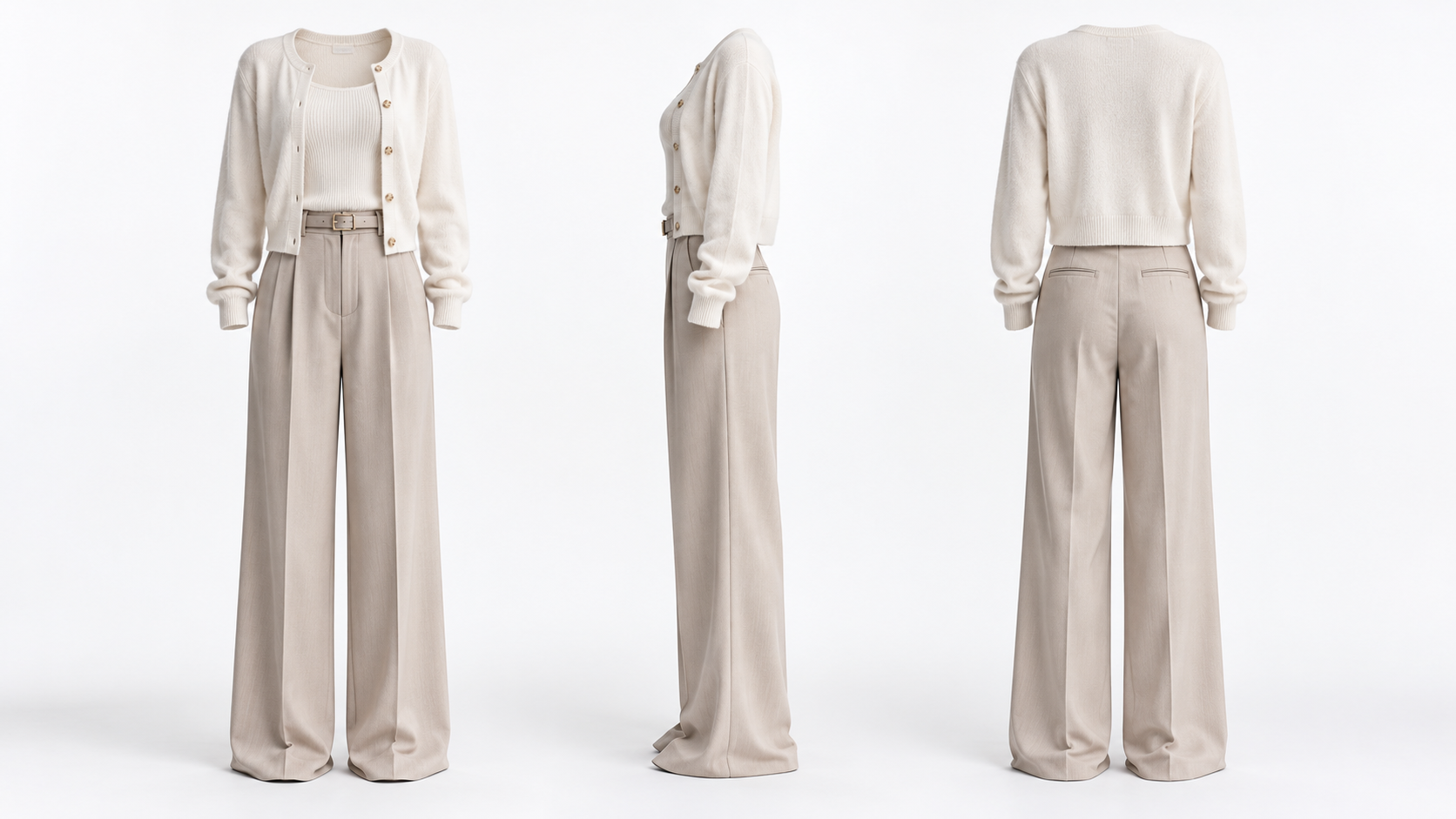
无人体隐形人台效果的完整服饰三视图参考板
Complete Clothing Three-View Reference Board with Invisible Mannequin Effect
根据用户上传的服饰参考图或文字/表格设计完整穿搭的商业服饰参考图。每套穿搭在横向16:9白或浅灰无缝背景上,以左正面、中间严格90度侧面、右背面三视图呈现。仅服饰呈自然穿着的立体体积,绝不出现人体、人台、支撑物或平铺衣物;三视图保持服装、比例和配饰一致且完整。
提示词 / Prompt
中文提示词
担任专业服装设计师、服装结构分析师与商业服饰摄影专家。根据根据用户指定的风格与场合设计一套完整协调的穿搭;未说明时克制地采用经典设计(one complete coordinated outfit based on the user's requested style and occasion; if unspecified, infer a restrained classic design),为每套完整穿搭制作写实三视图参考板。 输入模式与优先级 如提供可选服饰参考图,先判断用户是要求提取/还原原有穿搭,还是要求重新设计。提取模式以图中可确认内容为首要依据:识别上衣、下装、连体服、外套及可确认配饰;保留颜色、图案、材质、纹理、剪裁、长度、结构线、穿着顺序、搭配、比例和遮挡关系。遮挡区域仅依据可见线索克制补全;不得凭空增加复杂细节,也不得混搭不同人物的服装。用户明确要求改款时,以文字要求为准。未提供参考图时,直接根据文字描述、款式名称、类别、参数或表格设计,不要求用户必须上传图片。优先顺序为:当前任务明确要求、明确的参考图提取要求及参考图、用户文字服装要求、表格/类别经典特征、克制的专业补全。互相冲突的设计依据不得无故混用。 支持识别Markdown表格、普通文本表格、项目列表和自然语言。多行表格或多款式清单默认逐行处理为独立款式,各自形成完整搭配;除非用户要求,不得将不同款式的上衣、下装或颜色随机组合。仅提供款式名称时,按该类别经典特征补全完整设计;用户详细说明优先。考虑服装类别、季节、场合、版型适配、上下装结构、颜色、面料、纹理、宽松度及用户要求的配饰。仅推断形成完整服装所必需的缺失细节。款式较多时分批制作独立参考板,不得为了塞进一张图而缩小、裁切或省略视图。 隐形支撑:绝对禁止项 只展示处于可信自然穿着体积状态的服饰,仿佛由完全不可见的人体支撑。绝不出现人物、人体、皮肤、头部、面部、脖子、手、手臂、腿、脚、人体轮廓、骨架、解剖结构、身体网格、虚拟形象、模特、人台、裁缝人台、衣架、挂钩、支撑杆、展示架或底座。领口等开放处可以有自然内部阴影,但不得露出皮肤、人体轮廓或人台材料。不得平铺、折叠、悬挂、散落、堆叠或让服装塌陷。 服装立体形态与穿搭连续性 根据服装类型呈现真实的肩部、胸部、腰部、衣领、领口、袖子、腰头、臀部、裆部、大腿、小腿、裤脚、裙褶和下摆立体形态。两条裤腿保持分离。褶皱遵循重力、面料柔软度和服装受力,不可随机堆积。上衣与下装始终构成一套完整穿搭,保持正确腰线、遮盖、塞衣方式、接触、压褶及前后遮挡。仅使用参考图中可确认或用户文字明确要求的配饰,并自然佩戴或附着,不得悬浮。正、侧、背三视图必须为同一套服装及配饰。 三视图版式 制作一张横向16:9参考板,背景为纯白或极浅中性灰无缝影棚背景。依次排列三个完整且不裁切的视图:左侧正面、中间严格90度侧面、右侧真实背面。侧面清楚表现服装前后深度与侧面轮廓;背面呈现真实后片结构及下摆。三视图尽可能统一整体高度、视觉尺度、基准线和透视;视图之间留出足够空白,避免袖子、裤腿或下摆重叠。不得用三个近似正面的斜角视图代替正、侧、背。默认不添加标签、尺寸、箭头、标志、水印、边框或装饰;仅在用户要求时添加标签。 摄影表现 采用高端商业画册/产品摄影质感与真实隐形支撑服饰效果,准确表现面料纹理、缝线、厚度、接缝、自然重力褶皱和三维廓形。使用柔和、均匀、干净的影棚光塑造服装体积,不出现可见支撑物。产品摄影透视自然,三视图保持一致,避免广角畸变。成品应像真实面料经隐形支撑摄影或精细三维重建所得,而非插画、平面设计稿或带人体模型的渲染。 生成前明确输入模式、服装套数、关键细节、完整穿着关系和三视图方向规划;始终将禁止人体作为最高优先级。画面干净、专业、写实且前后一致。不添加虚构标志、随机文字、无关道具或布景。
English prompt
Act as a professional apparel designer, clothing-structure analyst and commercial garment-photography specialist. Create a realistic three-view reference board for each complete outfit using one complete coordinated outfit based on the user's requested style and occasion; if unspecified, infer a restrained classic design (根据用户指定的风格与场合设计一套完整协调的穿搭;未说明时克制地采用经典设计). INPUT MODE AND PRIORITY If an optional clothing reference image is supplied, first determine whether the user asks to extract/restore its actual outfit or requests a redesign. For extraction, use only visible evidence as the primary design basis: identify tops, bottoms, jumpsuits, coats and confirmable accessories; retain colors, patterns, materials, texture, cut, length, structural lines, wearing order, matching, proportions and occlusions. Complete obscured areas conservatively from visible clues; do not invent complex details or mix outfits from different people. For an explicitly requested redesign, follow the user's text instead. If no reference image is supplied, work directly from the written brief, style name, category, parameters or table; never require an image. Respect this priority: explicit current request, explicit reference-extraction request and its image, written clothing requirements, table/classic category traits, then restrained professional completion. Resolve conflicting design bases without mixing them. For tables or lists, read Markdown, plain-text tables, bullets and natural language. Treat each row as a separate candidate style. Make each a complete coordinated outfit; do not combine unrelated tops, bottoms or colors across rows unless asked. A short style name is enough to develop a complete classic design; detailed user specifications take precedence. Consider category, season, occasion, fit adaptation, top/bottom structure, colors, fabric, texture, fit and requested accessories. Infer only missing details needed for a coherent garment. For many styles, create separate boards in batches; do not shrink, crop or omit views to fit them all into one image. INVISIBLE SUPPORT: ABSOLUTE EXCLUSIONS Show the garments alone in a natural, credible worn volume, as if supported by an entirely invisible body. Absolutely no people, bodies, skin, heads, faces, necks, hands, arms, legs, feet, silhouettes, skeletons, anatomy, body meshes, avatars, models, mannequins, dress forms, hangers, hooks, rods, stands or display bases. Openings may contain natural internal shadow, but never skin, a body outline or mannequin material. Never flatten, fold, hang, scatter, stack or collapse the outfit. GARMENT FORM AND OUTFIT CONTINUITY Preserve realistic three-dimensional shoulders, chest, waist, collars, necklines, sleeves, waistband, hips, crotch, thighs, calves, leg openings, skirt pleats and hems as applicable. Keep both trouser legs spatially separate. Shape wrinkles according to gravity, fabric softness and garment tension, not randomly. Keep the top and bottom as one complete ensemble with correct waist height, coverage, tuck, contact, compression and front/back occlusion. Accessories must be confirmed in the reference or requested in text, naturally attached or worn, never floating. Front, side and back must show the same garments and accessories. THREE-VIEW BOARD Create one horizontal 16:9 board on a seamless white or very light neutral-gray studio background. Arrange three complete, uncropped views: front on the left, exact 90-degree side in the center, and true back on the right. The side view must reveal garment depth and side silhouettes; the back view must show actual rear construction and hems. Align overall height, scale, baseline and perspective across views. Keep enough spacing to prevent sleeves, legs or hems from overlapping. Do not substitute three near-front angles for front/side/back. By default add no labels, dimensions, arrows, logos, watermarks, borders or decoration; add labels only if requested. PHOTOGRAPHIC RENDERING Premium commercial lookbook/product photography with a realistic invisible-support garment effect. Show accurate fabric texture, stitching, thickness, seams, natural gravity folds and three-dimensional silhouette. Use soft, even, clean studio lighting that shapes the clothing without visible supports. Keep a natural product-camera perspective consistent across all views, without wide-angle distortion. The result should look like a real-fabric garment photographed with invisible support or carefully reconstructed in 3D—not an illustration, flat design draft or human-model render. Before rendering, identify the input mode, outfits, key details and complete wearing relationships, and plan the three orientations. Preserve the non-human rule above as the highest priority. Make the result clean, professional, realistic and visually consistent. No invented logos, random text, unrelated props or scenery.
探索更多图片和视频提示词 · 生成图片 · 生成视频 · 在 AI 画布中创作
相关作品
- 水晶蕨谷 · 新锐时尚
Moss Image 原创创意图集|新锐时尚|水晶蕨谷。原创提示词生成。
- 月光花冠 · 太空复古
Moss Image 原创创意图集|太空复古|月光花冠。原创提示词生成。
- 珍珠贝剧院 · 自然科学
Moss Image 原创创意图集|自然科学|珍珠贝剧院。原创提示词生成。
- 山水耳机 · 建筑杂志
Moss Image 原创创意图集|建筑杂志|山水耳机。原创提示词生成。
- 云层游泳池 · 黑白银盐
Moss Image 原创创意图集|黑白银盐|云层游泳池。原创提示词生成。
- 猫头鹰茶室 · 超现实拼贴
Moss Image 原创创意图集|超现实拼贴|猫头鹰茶室。原创提示词生成。