OpenZhenZhen AI 提示词画廊 · Claude Opus 5.5 · video
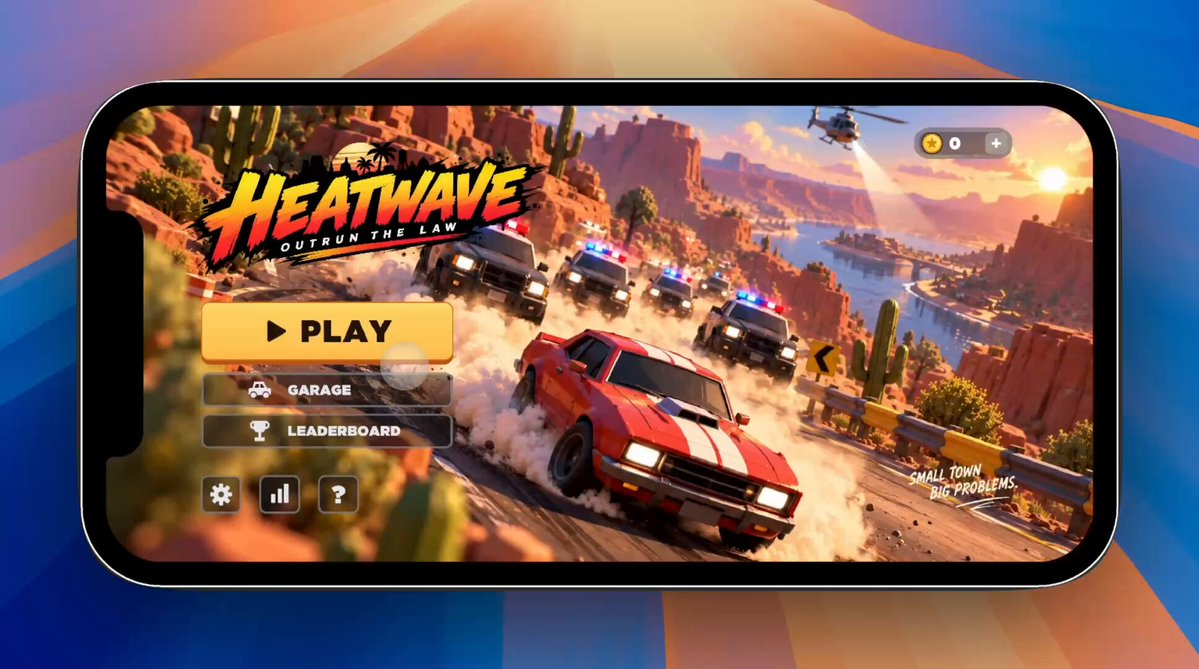
警察追逐街机风格游戏原型
Police Chase Arcade-Style Game Prototype
一款俯视角警察追逐街机游戏,由Claude Opus 5.5根据完整PRD文档在Unity中开发,使用了Topdown Engine插件和ChatGPT生成的美术素材。 原作需要参考素材;请自行准备图片、视频、音频、文档或代码库等输入。
提示词 / Prompt
English prompt
PRD — Police Chase Arcade Game Working title: Heatwave Platform: iOS + Android Engine: Unity Genre: Top-down 3D arcade chase / survival Orientation: Portrait Input: One-thumb touch controls Business model: TBD — design MVP around gameplay first Primary goal: Build a genuinely fun playable prototype before adding progression or monetization. ⸻ Product vision A fast, chaotic mobile arcade game where the player is constantly being pursued by increasingly aggressive police. The player cannot directly attack. Instead, they survive by driving aggressively, drifting around obstacles, making sudden turns and tricking pursuing police into crashing into obstacles and each other. The fantasy is: You’re not stronger than the police. You’re harder to catch. Runs should produce constant near-misses, chain collisions and moments where the player escapes a seemingly impossible situation. Think: easy controls + aggressive pursuit + physics chaos + escalating pressure. ⸻ Core gameplay loop START RUN ↓ DRIVE / DRIFT ↓ POLICE PURSUE ↓ BAIT POLICE ↓ DODGE ↓ POLICE CRASH ↓ GAIN SCORE ↓ WANTED LEVEL INCREASES ↓ MORE / HARDER POLICE ↓ SURVIVE ↓ EVENTUALLY GET CAUGHT ↓ SCORE / RESTART Target run duration: 2–5 minutes. Restart should take less than 2 seconds. ⸻ Design principles 3.1 One-thumb playable The player should be able to understand the controls within seconds. No accelerator. No brake pedal. No virtual steering wheel. The vehicle moves automatically. The player controls only direction. (I moved away from this after testing it the first time and added the onscreen joystick) 3.2 Arcade physics, not simulation Vehicles should: drift slide bounce spin collide dramatically recover quickly Fun takes priority over physical accuracy. 3.3 Pursuers are weapons Police are effectively the player’s offensive mechanic. The player should learn: “If I turn here, that cop is going straight into that wall.” 3.4 Chaos should remain readable Even with 10+ vehicles on screen, the player must immediately understand: where they are where they’re moving where police are coming from what can kill them 3.5 Failure should feel fair Death should generally result from a mistake the player understands rather than unpredictable physics. ⸻ MVP scope Do not build progression, upgrades, missions or monetization for the first milestone. The first version contains: 1 player vehicle 1 arena 1 police vehicle 1 elite police variant 5 wanted levels physics collisions environmental obstacles scoring player health police destruction basic VFX basic audio game-over screen instant restart That’s enough to determine whether the game deserves further development. ⸻ Player vehicle Movement Player vehicle uses a Rigidbody-based arcade controller. Do not rely heavily on realistic WheelColliders. Core variables should be exposed in the Unity Inspector: Acceleration Maximum Speed Turn Speed Turn Curve Lateral Grip Drift Factor Vehicle Mass Collision Force Drag Angular Drag Recovery Speed These need to be extremely easy to tune. ⸻ Controls Recommended first implementation: Drag steering Player touches anywhere on the lower portion of the screen. Dragging horizontally controls steering. ← drag turn left → drag turn right Vehicle accelerates automatically. Steering should be relative rather than absolute. The player should be able to lift their finger without immediately losing control. Alternative to prototype Test: Hold left/right side of screen = steer left/right. Don’t commit until both have been tested on a physical phone. ⸻ Drift system Drifting should happen naturally when turning at speed. No dedicated drift button. At low speed: high traction At high speed: reduced lateral traction This produces controlled sliding. Long drifts can optionally award score. Example: DRIFT +120 LONG DRIFT +340 But drift scoring is secondary to police destruction. ⸻ Police AI Police should feel: aggressive, predictable and slightly stupid. They should not simply follow the player’s current position. Instead, calculate an interception target based on player velocity. Conceptually: target = playerPosition + playerVelocity * predictionTime Police therefore try to cut the player off. ⸻ Police intelligence Police intentionally have limited obstacle avoidance. This is important. Perfect navigation would make the game less fun. Police should: pursue aggressively attempt interception avoid obvious static obstacles poorly account for other police overshoot turns collide with each other occasionally take dangerous routes This creates opportunities for the player. ⸻ Police destruction Police can be destroyed by: high-speed obstacle collisions hitting another police vehicle chain collisions environmental hazards The player does not have weapons. Example scoring: COP SMASHED +250 DOUBLE SMASH +600 TRIPLE SMASH +1,000 PILEUP! +2,000 Chain collisions should be heavily rewarded. ⸻ Wanted system Wanted level controls difficulty. ★☆☆☆☆ ★★☆☆☆ ★★★☆☆ ★★★★☆ ★★★★★ Wanted level increases based primarily on survival time and score. Level 1 2 police. Slow and forgiving. Level 2 3–4 police. Slightly faster. Level 3 5–6 police. More aggressive interception. Level 4 7–9 police. Elite police introduced. Level 5 Maximum chaos. 10+ police depending on device performance. Elite units appear frequently. The game should eventually become effectively impossible. That’s intentional. ⸻ Elite police The MVP only needs one special police type. Interceptor Visually distinct vehicle. Characteristics: faster than standard police lower mass aggressive prediction sharp steering easier to destroy in collisions This creates a glass-cannon pursuer. ⸻ Player health Use a simple health bar. Example: HULL ██████░░░░ Minor impacts: small damage. Heavy impacts: large damage. Extremely high-speed impacts: potential instant destruction. Police contact alone shouldn’t immediately kill the player. This allows chaotic scrambles. ⸻ Arena First arena should be compact. Something roughly equivalent to: ROCK ┌─────────────┐ │ │ │ ROCK │ │ │ │ ███ │ │ │ │ ROCK │ │ ROCK│ └─────────────┘ Obstacles need enough space between them for high-speed movement. Avoid procedural generation initially. Hand-design one good arena. ⸻ Environment For the first visual theme, I’d use something other than water so we’re not cloning the reference too closely. My preference: Desert outlaw chase Player is an outlaw escaping through a stylized desert environment. Environment contains: rock formations cacti barriers abandoned vehicles ramps fences small buildings dust destructible props It also fits the chunky visual language you’re already exploring with Bolt Pit. ⸻ Camera Top-down perspective camera. Not completely vertical. Something approximately: 55–70° downward angle. Camera follows player with smoothing. Camera should look slightly ahead in the player’s travel direction. At high speed: camera pulls back slightly. At low speed: camera moves closer. ⸻ Camera juice Small camera effects make a large difference. Light collision Tiny shake. Heavy collision Strong short shake. Police destruction Shake + tiny freeze frame. Example: 50–100 ms hit stop. Large pileup Slight zoom impulse + shake + particles. Don’t overdo continuous shaking. ⸻ Visual style Chunky stylized 3D. Characteristics: simplified geometry exaggerated proportions bright readable vehicles soft lighting minimal textures strong silhouettes exaggerated particles Avoid realistic vehicle proportions. Cars should feel almost toy-like. ⸻ VFX Minimum MVP effects: Player dust trail tire/skid marks drift smoke impact sparks Police siren lights smoke when damaged destruction explosion debris Environment dust destructible objects impact particles ⸻ Collision feedback Every significant collision should combine: physics + particles + audio + camera response. Major police destruction: IMPACT → physics impulse → vehicle fragments/debris → sparks → smoke → camera shake → hit stop → sound → score popup This interaction is one of the game’s main sources of satisfaction. ⸻ Score system Score comes from: ActionExample Surviving+10/sec Police destroyed+250 Driftvariable Near miss+100 Double collision+600 Triple collision+1,000 Large pileup+2,000 Exact values should remain configurable. ⸻ Near misses Optional for MVP but potentially valuable. Detect when a police vehicle passes extremely close to the player at high relative velocity. Display: CLOSE CALL! +100 This rewards risky driving. ⸻ UI During gameplay keep UI extremely minimal. SCORE COINS 13,590 14 ★★★☆☆ WANTED GAME HULL ████████░░ No minimap initially. Off-screen police can use subtle edge indicators. ⸻ Game over When hull reaches zero: brief slow motion. Player crashes. Then: BUSTED SCORE 24,850 BEST 31,220 [ AGAIN ] Tapping anywhere could restart. Avoid unnecessary menus between runs. ⸻ Audio The soundscape should sell speed and collisions. Required: engine tire squeal police sirens impact metal crunch debris destruction UI score sounds wanted level increase Sirens should become increasingly chaotic as wanted level increases. ⸻ Technical architecture Suggested Unity structure: GameManager Player ├── PlayerController ├── VehiclePhysics ├── PlayerHealth └── PlayerEffects Police ├── PoliceController ├── PoliceAI ├── VehiclePhysics ├── PoliceHealth └── PoliceEffects Systems ├── SpawnManager ├── WantedManager ├── ScoreManager ├── AudioManager ├── CameraManager └── PoolManager UI ├── HUD ├── WantedUI ├── ScoreUI ├── HealthUI └── GameOverUI Avoid building an elaborate framework. ⸻ Object pooling Police, particles and debris should use object pooling. Avoid frequent: Instantiate() Destroy() during gameplay. Mobile performance should be considered from the beginning. ⸻ Performance target Target: 60 FPS on a mid-range modern iPhone/Android device. Initial limits: ~12 active vehicles ~100 simple debris/particles simple shadows limited real-time lights Performance should be tested on device early. ⸻ Development milestones Milestone 1 — Greybox driving Build: empty arena cube player touch steering acceleration drifting camera Success criterion: Driving around an empty arena feels satisfying. Do not continue until it does. ⸻ Milestone 2 — The chase Add: one police vehicle pursuit AI interception collisions Success criterion: Dodging one police car is entertaining. ⸻ Milestone 3 — Emergent chaos Add: multiple police police-police collisions obstacles destruction scoring Success criterion: Player can intentionally cause: police → police and police → environment collisions. This is the critical milestone. ⸻ Milestone 4 — Escalation Add: wanted levels spawning difficulty scaling interceptor Now a run has an arc: calm ↓ pressure ↓ chaos ↓ panic ↓ death ⸻ Milestone 5 — Juice Add: particles camera shake hit stop skid marks dust sirens collision sounds score popups ⸻ Milestone 6 — Mobile build Build for real devices. Test: controls performance readability battery/thermal behaviour different screen ratios ⸻ Milestone 7 — Decide whether to continue At this point, stop development temporarily. Don’t immediately build a garage and 37 unlockable cars. Put the build in front of people. The important questions are: Do people immediately understand it? Do they restart after dying? Do they intentionally try to make cops crash? Does “one more run” happen naturally? If not, work on the core loop rather than adding content. ⸻ Phase 2 — only after validation If the prototype works, then expand into: Cars ↓ Coins ↓ Unlocks ↓ Challenges ↓ New arenas ↓ Special police ↓ Upgrades ↓ Daily challenges ↓ Leaderboards Potential environments: desert city docks snow industrial yard airport construction site military base And then there’s room for ridiculous police units: SUVs, armored vans, helicopters dropping roadblocks, etc. I have opened a @[Unity CLI installation] project which we can work in. The art style of the game should be fun and cartoony and the action also over the top. I have imported the Topdown engine into the project as well that we can use: https://topdown-engine.moremountains.com/ I want the game to be optimized for mobile, but should work on desktop while testing.
主题与风格
探索更多图片和视频提示词 · 生成图片 · 生成视频 · 在 AI 画布中创作
相关作品
- 金毛幼犬头时尚走秀
制作一段20秒、16:9画幅的电影感时尚秀场视频。一位身材矮小、拥有可爱金毛幼犬头部的类人角色自信地沿着T台行走,身穿黑色皮夹克、深色长裤和棕色鞋子。戏剧性的秀场灯光塑造画面,两侧观众席上坐满了观看时装秀的人。采用精致的时尚电影摄影风格、平滑的跟拍镜头,并清晰展现角色的服装与自信步态。
- 热带林中的黑色喷气机别墅
生成一段时长20秒、画幅16:9的电影感建筑可视化画面。展现一座外形如流线型黑色私人喷气式飞机的豪华现代住宅,与葱郁的热带森林自然融合。飞机两侧延伸的机翼容纳起居空间,宽阔的玻璃窗透出温暖的室内氛围灯光。住宅架高于精心规划的花园之上,下方有蜿蜒步道和宁静的游泳池。周围环绕茂密的热带绿植、远处群山与柔和的傍晚天空。整体氛围宁静而雅致,将精致的现代建筑与自然环境融为一体。镜头从宽阔的全景建立画面,再平稳缓慢地向住宅靠近,展现明亮的室内、机翼形起居空间,以及下方的花园与泳池。全程保持喷气式飞机造型住宅清晰可辨且视觉连贯。
- 暮色里的家
创作一段20秒、16:9的电影感视频。以黄昏时分一栋20世纪90年代郊区住宅的平稳航拍镜头开场。缓缓靠近房屋,并流畅地穿过前门进入复古风格的客厅。最后以特写呈现一只手正准备将磁带放入录音机。整个镜头中,光线自然地实时从白昼渐变至夜晚。采用温暖怀旧的90年代风格、柔和的运镜和连贯梦幻的转场。不出现文字或标志,也不包含音频。
- 雨夜巷中寻线索
生成一段20秒、16:9的电影感写实视频。夜晚,纽约一条典型的小巷里,雨水打湿的地面在几盏昏暗路灯下映出鲜艳色彩。巷道两侧是布满各色涂鸦的老砖墙,旁边放着垃圾桶。透过部分遮挡视线的墙壁,可以看到几栋高楼的一角,以及远处有车辆和行人的繁忙街道,呈现城市环境。一名侦探注意到地上的一张纸,弯腰将它拾起,并以警觉、专注的神情仔细查看。镜头平稳缓慢地推近侦探,最后近距离呈现侦探手中的纸张。全程保持真实的电影光线、鲜艳色彩和连贯自然的动作。
- 篝火旁的沉思
生成一段时长15秒、画幅比例16:9的电影感场景。黄昏时分,赫拉克勒斯坐在森林中的篝火旁,静静回想着刚刚取得的胜利。镜头从他的面部特写开始:他疲惫却如释重负,神情沉思,火光柔和地映照着脸庞,摇曳的阴影掠过他的面容。他凝望火焰,一只手搭在剑柄上。镜头缓慢拉远,展现前景中的宁静篝火以及环绕四周的幽暗森林。以温暖跳动的火光映衬清冷阴暗的树林,营造宁静沉思的氛围。不要对白、字幕或文字。
- 流光幽灵
制作一段20秒、16:9的电影感奇幻视频。画面中是一位由光与能量构成的空灵幽灵般成年女性,鲜艳多彩的发光光流从她身体周围流动、延展。她姿态优雅,气质超凡,流动的光线是画面的核心视觉焦点。场景保持昏暗简洁,以突出光芒;能量呈现流畅动态、柔和辉光与细腻的发光质感。整个视频中保持她的外观一致,不出现文字或标志。使用提供的身份参考图确定她的外观。