OpenZhenZhen AI Prompt Gallery · GPT Image 2.6 · image
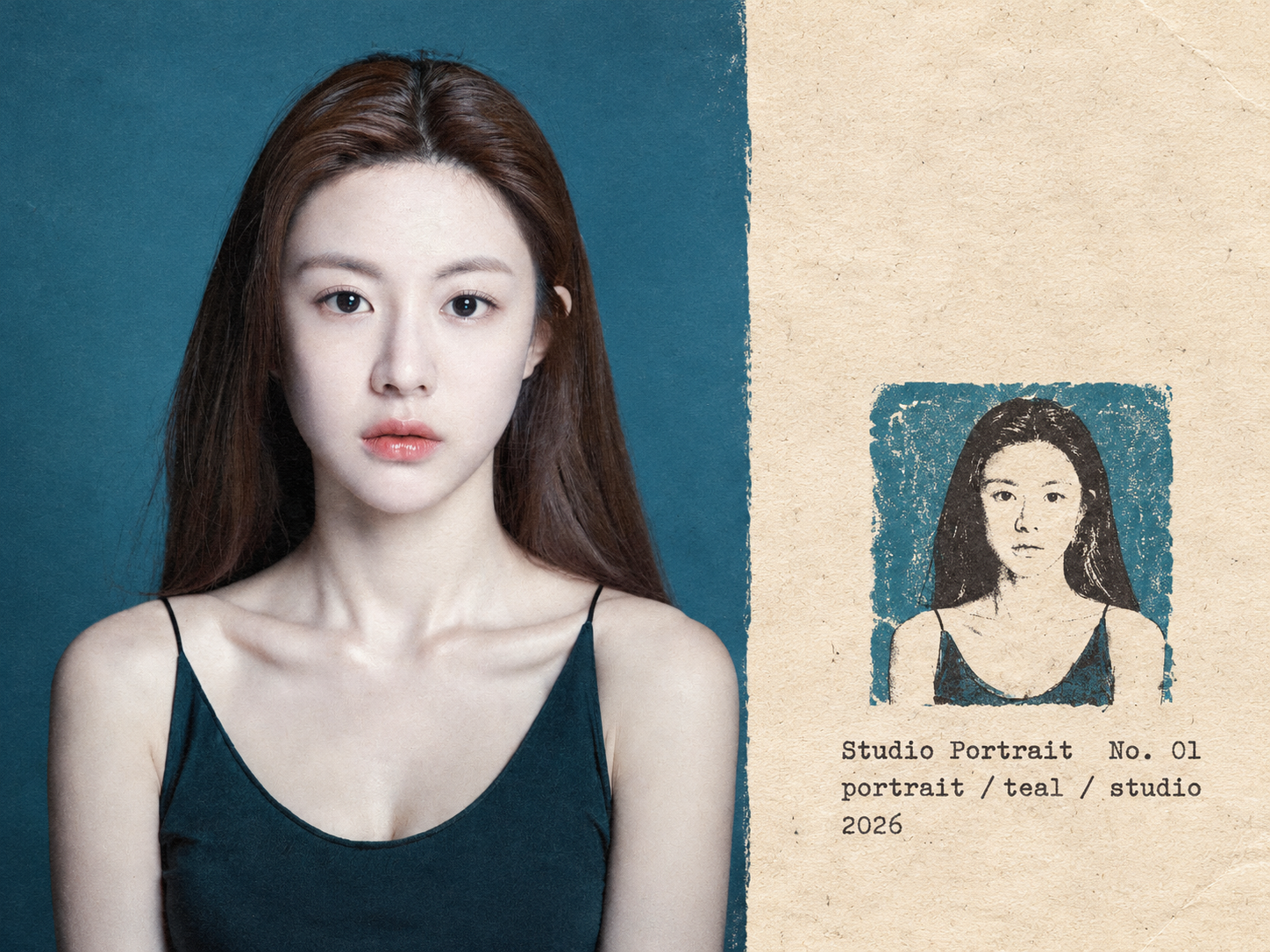
Studio Portrait Rubber Stamp Field Notes Poster
Studio Portrait Rubber Stamp Field Notes Poster — explore this GPT Image 2.6 creation on OpenZhenZhen, with its original prompt and a reusable generation example.
Prompt
Chinese prompt
将随附的单张完整参考照片单独制作为一张 4:3 横向“橡皮章旅行实地笔记海报”;不得拼贴或组合多张图片。本次整理中,完整且未裁切的 ref-10a-v1 文件同时作为原始照片与唯一身份参考。只为适配版式在左侧区域自然取景;绝不拉伸、扭曲、偏移、替换或重绘原照。 采用左右自然衔接的构图,不画明显分割线。左侧占画面 58%,忠实保留随附照片中的成年女性、面部、可见发型、肩部、黑色细肩带、纯净的蓝绿色摄影棚背景、空间关系、自然光影、纹理和色彩氛围。只作克制的艺术出版级调色,并添加极其细微的胶片颗粒。左侧保留为原始摄影记录;不添加原图中不存在的风景、道具、人物或地理环境。 右侧占画面 42%,使用温暖米白色陈旧纸张,呈现细微纤维、自然纹理、轻微使用痕迹和哑光质感,保留充足的未印刷留白。仅把照片中可见且有辨识度的人像轮廓与色彩关系压缩为小型多色雕刻橡皮章:女性可见的头肩轮廓、深色长发、黑色细肩带和简洁的蓝绿色摄影棚底色。不得虚构地标、风景或地点。印章放在纸面区域中下方,高度仅占该区域的 30%–38%;保持小型印章效果,不得变成完整人像插画或标志。 对于这张纯背景摄影棚人像,使用“Studio Portrait”作为明确标示的虚构摄影棚主题名,而非地理地点或照片拍摄地声明。添加“No. 01”作为选定的设计序号,三个且仅三个简短英文关键词“portrait / teal / studio”,以及“2026”作为选定的设计年份。这些都是设计标签,不是照片元数据、旅行事实或拍摄日期。将它们排在印章下方或旁侧的留白处,使用小号、克制、略带机械瑕疵的打字机字体。所有字串须与引号中的拼写完全一致。不添加口号、品牌或装饰文字。 从原照提取 2–4 种沉稳专色,例如蓝绿色/板岩蓝、碳黑和克制的暖中性色;如可见原图显示更合适的颜色,不必强行套用示例色板。每种颜色分别呈现手工盖印层:橡皮章刻制痕迹、手工雕刻线条、粗细不均、轮廓缺口、破碎边缘、干墨缺印、透纸感、颗粒油墨、压力不匀、局部重影和约 1–2 mm 的细微套印错位。允许各色层自然错位,边缘不得数字平滑。印迹应像真实压在陈旧纸张上的雕刻印章,而非滤镜、平滑矢量或线描标志。 仅在相应形态确实可见时采用场景提炼方式:标志性建筑可保留独特屋顶、圆顶、拱门、塔楼或主体轮廓;山地聚落可压缩为少量阶梯色块;海滨可保留山形、聚落层次、海岸线与稀疏水纹;城市全景可保留主要天际线、一座标志性建筑和一两层远山;自然景观可保留主要山形、树木、海岸线或道路走向。只有照片中确实存在且具有叙事意义时,才保留前景遮挡。当前摄影棚人像没有这些地理形态,因此不得添加。 整体保持安静、克制、触感真实、手工制作且可收藏的实地笔记氛围。可见人物为明确成年女性;左侧原照中的身份保持不变,印章中不另加人物。不要推断族裔、真实地点、旅行、事件或拍摄日期。避免明显中央分割线、圆形或红色印章、邮票齿孔、火漆印章、贴纸拼贴、旅游纪念品模板、通用城市图标、细节过密、幼稚手工感、卡通、3D 渲染、塑料质感、光亮数字渐变、过饱和、文字过多、装饰杂乱,以及任何对左侧原始照片的更改。
English prompt
Create one separate 4:3 landscape Rubber Stamp Travel Field Notes Poster from the single complete attached reference photo; do not make a collage or combine images. For this curation the complete, uncropped ref-10a-v1 file serves as both the original photo and the sole identity reference. Fit the source into the left panel only with natural layout cropping where needed; never stretch, distort, shift, replace or redraw it. Use a seamless left/right composition with no visible divider. The left region occupies 58% of the frame and faithfully preserves the attached photo’s adult woman, face, visible hair, shoulders, black straps, plain teal-blue studio background, spatial relationships, natural light and shadows, textures and color atmosphere. Apply only restrained art-publication color grading and extremely subtle fine-grain film noise. Preserve the original as the photographic record; add no scenery, props, people or geography absent from it. The right region occupies 42% and uses warm off-white aged paper with subtle fibers, natural grain, light wear and a matte finish. Leave generous unprinted whitespace. Extract only the distinctive visible portrait outline and color relationships into a small multicolor carved-rubber stamp: the woman’s visible head-and-shoulders silhouette, long dark hair, black straps and simple teal studio field. Do not invent a landmark, landscape or location. Place the stamp in the lower-middle of the paper area, only 30%–38% of that region’s height; it must remain a small stamp, not a full portrait illustration or logo. For this specific plain-background studio portrait, use “Studio Portrait” as an explicitly fictional studio-theme name, not a geographic place or claim about where the photo was taken. Add “No. 01” as a chosen design sequence number, exactly three short English keywords “portrait / teal / studio”, and “2026” as the selected design year. These are design labels, not image metadata, travel facts or a capture date. Put them below or beside the stamp in small restrained typewriter lettering with slight mechanical imperfections. Spell every string exactly as quoted. Add no slogans, brands or decorative copy. Extract 2–4 subdued spot inks from the actual photo, such as teal/slate blue, carbon black and a restrained warm neutral, without forcing a palette if the visible image suggests otherwise. Render each color as a separate hand-stamped layer with carved-rubber marks, hand-engraved lines, uneven widths, contour notches, fractured edges, dry-ink shortages, paper show-through, granular ink, uneven pressure, partial ghosting and about 1–2 mm of subtle misregistration. Allow natural layer misalignment; do not digitally smooth edges. The print should look physically stamped on aged paper, not like a filter, smooth vector or line-art logo. Use scene-dependent extraction only when the corresponding forms are actually visible: iconic architecture may retain its distinctive roofs, domes, arches, towers or main contours; mountain settlements may become a few terraced color blocks; coasts may retain mountain contours, settlement layers, shorelines and sparse water ripples; city panoramas may retain the main skyline, one iconic building and one or two distant mountain layers; natural landscapes may retain primary mountain forms, trees, shorelines or road directions. Retain a foreground occlusion only if it is visibly present and narratively important. For this studio portrait, none of these geographic forms is present, so do not add them. Keep the field-note mood quiet, restrained, tactile, handmade and collectible. The visible person is clearly adult; preserve her identity in the left photo and make no additional person in the stamp. Do not infer ethnicity, a real location, travel, event, or capture date. Avoid an obvious central divider, circular or red seal, postage perforations, wax seal, sticker collage, tourist-souvenir template, generic city icon, exhaustive copying, dense detail, childish craft, cartoon, 3D render, plastic texture, glossy digital gradients, oversaturation, excessive text, decorative clutter, or any alteration to the left original photo.
Explore more AI image and video prompts · Try image generation · Try video generation · Create on the AI canvas
Related works
- Scene Grid
Scene Grid — explore this moss-image creation on OpenZhenZhen, with its original prompt and a reusable generation example.
- Scene Grid
Scene Grid — explore this zhenzhen-image-g-v2.6-lowprice creation on OpenZhenZhen, with its original prompt and a reusable generation example.
- Besties (For Sure)
Besties (For Sure) — explore this zhenzhen-image-g-v2.6-lowprice creation on OpenZhenZhen, with its original prompt and a reusable generation example.
- Hidden Blade - Heroine
Hidden Blade - Heroine — explore this zhenzhen-image-g-v2.6-lowprice creation on OpenZhenZhen, with its original prompt and a reusable generation example.
- You Are the One I Must Not Forget!
You Are the One I Must Not Forget! — explore this zhenzhen-image-g-v2.6-lowprice creation on OpenZhenZhen, with its original prompt and a reusable generation example.
- High-Definition Portrait
High-Definition Portrait — explore this seedream-v5.5-t2i creation on OpenZhenZhen, with its original prompt and a reusable generation example.