OpenZhenZhen AI Prompt Gallery · GPT Image 2.6 · image
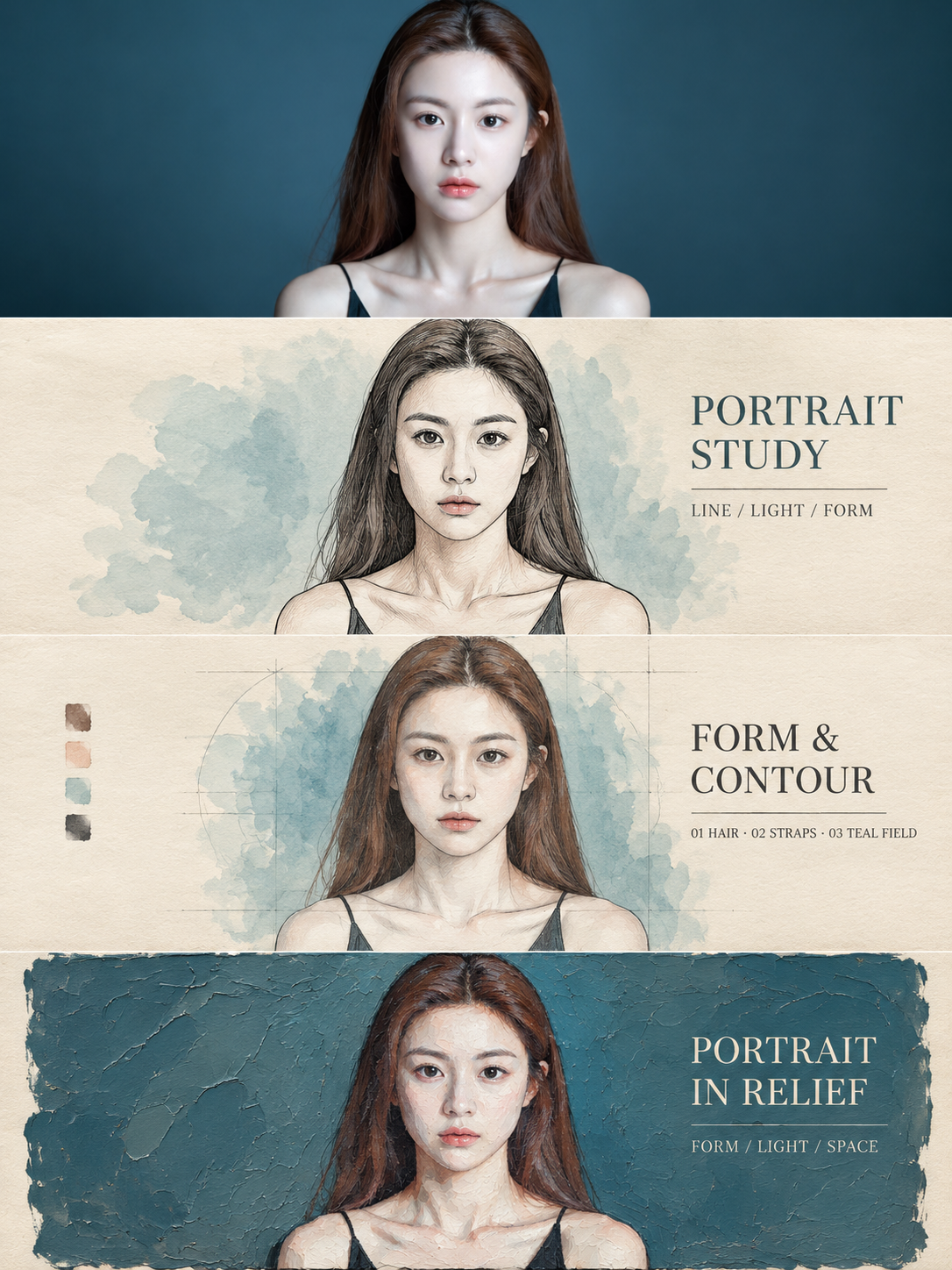
Four-Layer Portrait Style Translation Poster
Four-Layer Portrait Style Translation Poster — explore this GPT Image 2.6 creation on OpenZhenZhen, with its original prompt and a reusable generation example.
Prompt
Chinese prompt
将完整、未经裁切的附加 identity_reference ref-10a-v1 只绑定一次,同时作为四层共用的唯一原照片和面部身份参考。图中是一位明确成年的女性,居中的头肩至上胸棚拍肖像,深棕色长直发、黑色细肩带、直视镜头,背景为冷调蓝灰/青灰色。四层均保留同一主体、同一时刻、裁切、比例、姿势、视线、观察方向和空间关系。不得裁切附件,不扩展可见上胸以外的身体,也不虚构地点、旅行场景、陪伴者、动物、道具、姓名、坐标或日期。来源台账中的示例图仍为待处理状态,不作为本次输入。 制作一张独立的3:4竖版高级海报,不拼接多张照片。自上而下将整幅画面分成四条等高、无缝横向区域,顺序如下,每层精确占总高度的25%。四层主体大小与视觉重心尽量对齐。每层都是约3:1的扁横幅,横向组织并留出左右空间,每层都完整铺满;不要拉伸主体或裁掉头部、肩部及关键可见内容。不得留缝、加分割线、边框、层编号、标志或水印。第一层放入完整原照;如需适配,只向两侧延展棚拍背景。 第一层——原始摄影:保留实际照片状态,作为后三层转译的基准。保持可见面部身份、头发、黑色肩带、裁切、直视镜头、棚拍背景、自然比例、光线、阴影和色彩。不做插画化、纹理转换、几何化或3D重构;避免磨皮和虚构场景。 第二层——真实场景与规则线稿:将同一肖像转为纤细准确的黑色线条、清晰透视与结构、选择性轮廓、克制几何组织、有序细节和留白。只表现实际可见的头发、面部轮廓、肩部/肩带和背景。颜色从原图少量提取:深棕、黑色、冷调青蓝灰、自然肤色、柔和唇色和暖纸色。顶部放醒目的主标题“PORTRAIT STUDY”,并加小型副标题“LINE / LIGHT / FORM”。文字保持准确、简洁、清晰;仅作中性设计文案,不是个人或地点事实。不要虚构招牌。 第三层——轴测分层水彩结构研究图:在暖象牙白水彩纸上,将同一完整头肩肖像表现为克制的轴测研究图。保持其轮廓、比例、观察方向、位置和原图色彩。仅识别照片中实际可见的3–7个辨识线索,并使用4–6种来自原图的颜色;结合细线、半透明水彩色块、轻微纸纹、少量结构辅助线和克制分析标记。人物身体保持完整:用2–5层完整叠加的轮廓/明暗层或姿势线,间距适度,以完整半身轮廓为稳定锚点;严禁解剖、爆炸拆分或杜撰身体部件。沿轴线或留白放置短标题“FORM & CONTOUR”和微型注释“01 HAIR · 02 STRAPS · 03 TEAL FIELD”,仅描述可见特征。 第四层——轴测立体厚涂空间:将同一完整可见半身转译成体积清楚、落点稳定的小型立体形态,保留身份线索、裁切、姿势、视线和对齐关系。以仅来自照片冷调青灰棚拍背景的厚涂色域承托;加入有触感的刮刀笔触、叠加颜料边缘和真实纸面纹理。头发保持深棕、肩带黑色、肤色自然;保留宽阔暖纸留白,不设第二视觉中心。不要新造房间、风景、旅行场景、底座、道具或下半身。沿颜料边缘或留白加入小标题“PORTRAIT IN RELIEF”和注释“FORM / LIGHT / SPACE”;这些只是中性的设计词,不是事实陈述。 四层从摄影、线稿、水彩研究到有触感的厚涂连续演化,同时保持为同一张可辨识肖像。第一层不加文字;第二至第四层只使用上述指定标题和注释。不要添加真实姓名、地名、地址、坐标、编号、年份或其他无依据事实。避免乱码、杂乱、无关风景、无依据结构、身体扭曲、机械解剖、卡通、商业化精致感、塑料或玩具感3D、廉价渲染和额外文字。
English prompt
Use the complete, uncropped attached identity_reference ref-10a-v1 once as both the sole source photo and facial-identity reference. It shows one clearly adult woman in a centered head-and-shoulders/upper-chest studio portrait, with long straight dark-brown hair, black thin straps, a direct gaze, and a cool blue-gray/teal background. Preserve that same subject, moment, crop, proportions, pose, gaze, viewing direction and spatial relationships in all four layers. Do not crop the attached file, extend the body below the visible crop, or invent a location, travel scene, companions, animals, props, names, coordinates or dates. The source-ledger example is pending and is not an input. Make one independent premium 3:4 vertical poster, not a collage of photos. Divide the full frame top-to-bottom into four equal seamless horizontal bands in this order, each exactly 25% of the total height. Keep their subject size and visual center aligned. Each band is an approximately 3:1 horizontal banner; leave side breathing room, fill every band, and do not stretch the subject or cut off the head, shoulders or key visible content. No gaps, divider lines, borders, layer numbers, logos or watermarks. Fit the whole source photo in Layer 1; only extend its studio background sideways if needed. Layer 1 — Original Photography: retain the actual photograph as the benchmark for the next three translations. Preserve visible facial identity, hair, black straps, crop, direct gaze, studio background, natural proportions, light, shadow and colors. No illustration, texture transformation, geometrization or 3D reconstruction; avoid smoothing and fictional scenery. Layer 2 — Real Scene and Regular Line Drawing: translate the same portrait into slender accurate black lines, clear perspective and structure, selective contours, restrained geometric organization, orderly details and negative space. Use the actual hair, face outline, shoulders/straps and background only. Derive a few colors from the photo: dark brown, black, cool teal-blue-gray, natural skin, muted lip color and warm paper. At the top place the striking main title “PORTRAIT STUDY” and the small subtitle “LINE / LIGHT / FORM”. Keep both exact, concise and legible; they are neutral design copy, not factual personal or location data. Invent no signage. Layer 3 — Axonometric Layered Watercolor Structure Study: render the same intact head-and-shoulders portrait as a restrained axonometric research study on warm ivory watercolor paper. Preserve its outline, proportions, viewing direction, placement and source colors. Identify only 3–7 cues actually visible in the photo and 4–6 source-derived colors; use fine linework, translucent watercolor blocks, slight paper texture, a few structural guides and restrained analytical marks. Keep the person intact: use 2–5 complete overlapping contour/value layers or posture lines, with modest spacing and one stable bust silhouette as anchor; never dissect, explode or invent body parts. Set the short title “FORM & CONTOUR” and tiny notes “01 HAIR · 02 STRAPS · 03 TEAL FIELD” along the axis or whitespace. These notes describe visible features only. Layer 4 — Axonometric 3D Impasto Space: translate that same intact visible bust into a small dimensional form with clear volume and stable grounding, keeping identity cues, crop, pose, gaze and alignment. Ground it in a tactile thick-paint field derived solely from the photo’s cool teal-gray studio background; use raised palette-knife marks, layered paint edges and real-paper texture. Keep hair dark brown, straps black and skin tones natural; allow generous warm-paper whitespace and no second focal point. Do not create a room, landscape, travel setting, pedestal, props or lower body. Add the small exact title “PORTRAIT IN RELIEF” and note “FORM / LIGHT / SPACE”, integrated with the paint edge or whitespace. These are neutral design words, not factual claims. Evolve continuously from photography to line drawing, watercolor research and tactile impasto while keeping one recognizable portrait. Layer 1 has no added text; Layers 2–4 use only the specified title/note groups. Add no real name, place, address, coordinates, serial data, year or other unsupported fact. Avoid garbled text, clutter, unrelated scenery, unsupported structure, distorted anatomy, mechanical dissection, cartoon styling, commercial polish, plastic or toy-like 3D, cheap rendering, and extra text.
Explore more AI image and video prompts · Try image generation · Try video generation · Create on the AI canvas
Related works
- Scene Grid
Scene Grid — explore this moss-image creation on OpenZhenZhen, with its original prompt and a reusable generation example.
- Scene Grid
Scene Grid — explore this zhenzhen-image-g-v2.6-lowprice creation on OpenZhenZhen, with its original prompt and a reusable generation example.
- Besties (For Sure)
Besties (For Sure) — explore this zhenzhen-image-g-v2.6-lowprice creation on OpenZhenZhen, with its original prompt and a reusable generation example.
- Hidden Blade - Heroine
Hidden Blade - Heroine — explore this zhenzhen-image-g-v2.6-lowprice creation on OpenZhenZhen, with its original prompt and a reusable generation example.
- You Are the One I Must Not Forget!
You Are the One I Must Not Forget! — explore this zhenzhen-image-g-v2.6-lowprice creation on OpenZhenZhen, with its original prompt and a reusable generation example.
- High-Definition Portrait
High-Definition Portrait — explore this seedream-v5.5-t2i creation on OpenZhenZhen, with its original prompt and a reusable generation example.